
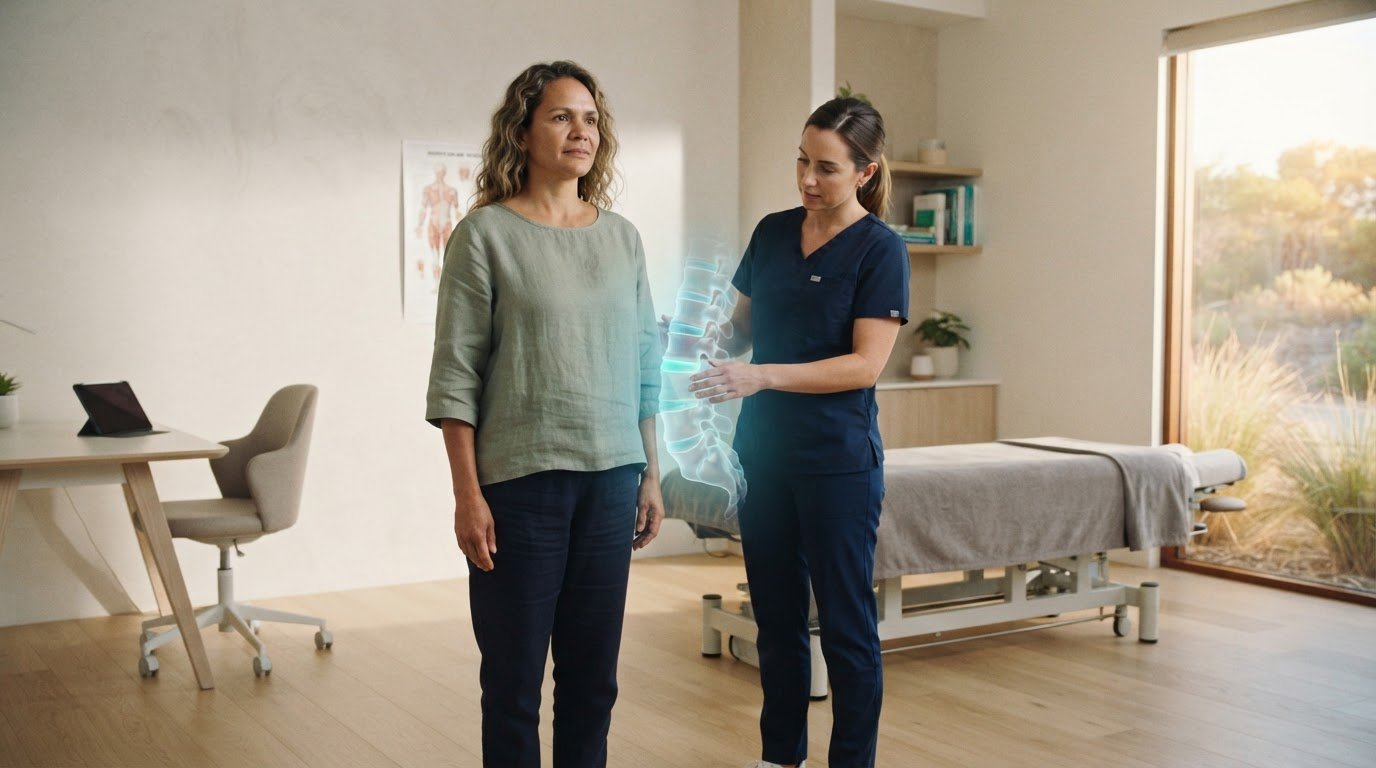
An L5 disc finding is a starting point for assessment, not a treatment plan. Whether L5 disc issue chiropractic care is suitable cannot be decided from an MRI report alone.
If you’ve seen “bulge” or “herniation” on a scan, it’s understandable to wonder whether the finding explains your back pain or leg symptoms, and whether movement could make things worse. Disc changes don’t always cause symptoms, so the report needs to be considered alongside how you feel and what an examination shows.
This guide explains what L5 disc terms mean, what a chiropractic assessment can help clarify, and when further medical assessment matters. You’ll also learn what chiropractic adjustments may involve and why their suitability depends on your individual presentation, not just a scan. At Golden Bay Chiropractic Works, spinal examinations and posture analysis can inform a discussion of your symptoms and needs. We’ll also cover warning signs that call for urgent medical attention, so you can take your next step with greater clarity.
Key Takeaways
- L5 names a vertebra, not a diagnosis. L4-L5 and L5-S1 refer to different disc locations.
- With an L5 disc issue, chiropractic care may be considered in relation to your symptoms and movement goals. It should not be presented as putting a disc back in place.
- Keep track of your symptoms and discuss them during an assessment. Imaging decisions depend on your situation.
- Golden Bay Chiropractic Works can use a spinal examination and posture analysis to help discuss appropriate next steps.
What does an L5 disc issue mean for your lower back?
Your lumbar spine is the lower-back section of your backbone. It contains five vertebrae, named L1 to L5 from top to bottom, with flexible discs between them. These discs help absorb load and allow movement. L5 names the lowest lumbar vertebra. On its own, it isn’t a diagnosis and doesn’t explain the cause of pain.
A disc finding describes what a scan shows. It helps explain pain only when it fits your symptoms and clinical assessment. Disc changes can appear on imaging without causing symptoms, so a report needs context.
Where are the L4-L5 and L5-S1 discs?
Think of the spine as a stack: the L4-L5 disc sits between the fourth and fifth lumbar vertebrae; the L5-S1 disc sits below L5, between the fifth lumbar vertebra and the top of the sacrum, the base of the spine. These are different levels. Both can be discussed in relation to a spinal disc herniation, but the level named in a report doesn’t, by itself, identify the source of your pain.
A bulge, herniation or other disc change is a description, not proof that the disc is causing your symptoms. The finding needs to be considered alongside your history and examination.
What symptoms can accompany a lumbar disc issue?
Some people report lower-back pain, while others may feel pain travelling into the buttock or leg. Tingling, numbness or weakness can also occur in some cases. Symptoms vary, and similar sensations can have different causes. A list of symptoms alone can’t diagnose sciatica or establish that a nerve is involved.
If you’re considering L5 disc issue chiropractic care, start by describing what you feel, when it began and how it affects movement. Note whether symptoms stay in your back or travel into a leg, and whether they are changing. The scan level is one piece of information, not the whole answer.
Can chiropractic help with an L5 disc issue without promising a cure?
An adjustment shouldn’t be described as putting a disc back in place. Chiropractic care may be discussed in relation to symptoms and movement goals, but that’s different from claiming it changes a disc’s structure. Whether L5* disc issue chiropractic* care is suitable depends on your symptoms, examination findings and relevant health history. For wider musculoskeletal and spinal discomfort, patients also frequently consider complementary therapies, such as acupuncture and manual care offered by המרכז לרפואה סינית לטיפול בכאב ובעיות אורטופדיה, to help manage persistent pain.
What can an individual chiropractic assessment clarify?
At Golden Bay Chiropractic Works, a spinal examination provides an opportunity to discuss your symptoms and assess your individual needs. Be ready to explain when symptoms began, what seems to affect them, and whether they’re changing. These details, together with your health history and examination findings, help inform a discussion about whether chiropractic adjustments may be appropriate. An assessment can guide care discussions, but it can’t guarantee a particular result or replace further medical assessment when that’s needed.
What should you expect from realistic care discussions?
Be clear about what you hope to do more comfortably, such as walking, sleeping, or managing occupational demands like long-distance driving. For professionals in transport or heavy vehicle roles where lower back health directly affects vocational fitness, clinics like Miami CDL/DOT Physical Exam Center outline how driver health assessments and regulatory compliance standards evaluate physical readiness. Ask how proposed care relates to that goal, what uncertainties remain and what changes should prompt a review. You can also discuss how progress will be considered in terms of your symptoms and day-to-day activities, rather than relying only on a scan description. A realistic conversation makes room for your questions and for reviewing the plan if your symptoms change.
Chiropractic care can’t guarantee disc healing or that your symptoms will resolve. The focus of any discussion should be your presentation and agreed goals, not a promise to repair a scan finding or a fixed timeline for improvement.
If you’re weighing up next steps, Golden Bay Chiropractic Works can discuss your concerns as part of a spinal examination. You can explore spinal examination and posture analysis as a way to begin that conversation.
What should you do next if you suspect an L5 disc issue?
Keep the next steps simple. Note what you’re experiencing, arrange an appropriate assessment, then discuss what the findings mean before choosing care. If you’re considering L5 disc issue chiropractic care, don’t let a scan report alone determine your next move.
- Write down when symptoms began and whether they’re changing.
- Notice what affects them, and whether pain or other sensations travel into a leg.
- Discuss your symptoms and health history with a health professional before deciding on care.
Imaging isn’t automatically needed for every suspected disc issue. Whether a scan is useful depends on your symptoms, examination and clinical context. If you already have a scan report or other relevant health information, bring it along so it can be considered alongside how you’re feeling.
What information is useful at an assessment?
Specific observations help. For example, note whether symptoms started after an activity, worsen with a particular movement, or extend below the buttock. You don’t need to interpret these details yourself. Sharing them clearly can help guide the assessment and discussion of suitable next steps.
When do symptoms need urgent medical attention?
Seek urgent medical care if you develop new difficulty controlling or emptying your bladder or bowel, numbness around the saddle area (the inner thighs, genitals or area around the anus), or rapidly worsening leg weakness. These symptoms need prompt assessment. In Australia, call 000 for an emergency or go to a hospital emergency department.
Routine symptoms can be assessed through an appropriate appointment; new bladder or bowel changes, saddle-area numbness or rapidly worsening weakness need urgent medical attention.
For a discussion of your symptoms and an individual spinal examination, book an assessment with Golden Bay Chiropractic Works.
L5 disc issue chiropractic care in Golden Bay: local next steps
If you’re weighing up L5 disc issue chiropractic care, a local conversation can help you move from uncertainty to a clearer understanding of your options. Golden Bay Chiropractic Works provides chiropractic spinal examinations, posture analysis and chiropractic adjustments for people in Golden Bay and nearby communities, including Secret Harbour, Singleton, Madora Bay, Karnup, Port Kennedy, Warnbro, Waikiki, Rockingham, Mandurah, Silver Sands, Greenfields, Serpentine and Baldivis.
Dr Barrie Miller at Golden Bay Chiropractic Works has over 35 years of experience. That experience supports an informed discussion, not a guarantee of disc healing or a particular outcome. Your symptoms, health history and assessment findings remain central to deciding what care may be suitable.
What can a first conversation focus on?
Bring the details that matter to you: what you’re feeling, when it began, how it affects daily activities, and any scan reports or previous assessment information you have. The comprehensive spinal examination guide can help you understand what to expect and prepare for a focused discussion of your concerns and presentation.
How do adjustments fit into an individual care plan?
Chiropractic adjustments are one of the services offered by Golden Bay Chiropractic Works. Their suitability should be considered in light of your individual presentation. A discussion can clarify the purpose of any proposed care, your goals and what to do if symptoms change. An adjustment shouldn’t be presented as putting a disc back in place. The chiropractic adjustments guide can help you understand what the service involves as you consider those questions.
If you’re ready to explore your next step, Golden Bay Chiropractic Works can discuss your concerns and assessment information. Bring your questions and any relevant reports to help focus the conversation on your presentation and the options that may suit you.
Take your next step with confidence
You don’t need to have every answer before seeking guidance. Start with the question that matters most to you, whether that’s understanding a scan report, feeling safer about movement or discussing whether L5 disc issue chiropractic care could suit your circumstances. A useful next step gives you room to explain your concerns and understand the options without pressure to expect a particular outcome.
At Golden Bay Chiropractic Works, you can have an individual discussion about your spinal health and possible care. Bring the information you have, and be open about what you hope to get back to doing. Clear questions can help make the conversation more useful.
Book an assessment with Golden Bay Chiropractic Works to discuss your concerns and take a considered step towards understanding what may work for you.PH 08 9537 1226
Frequently Asked Questions
Can an L5 disc issue appear on an MRI without causing symptoms?
Yes. An MRI can show a disc change even if you feel well. A report might mention a bulge at a level where you have no discomfort. That result alone isn’t a reason to seek treatment. If you’re symptom-free, keep the report for reference and discuss it if it becomes relevant during a later health conversation.
How long does an L5 disc issue take to improve?
There isn’t one recovery timeline that applies to everyone. Progress can depend on your symptoms, general health and what you need to get back to doing. Rather than judging progress by a scan label, notice practical changes, such as whether getting dressed or sitting through a meal becomes easier. Seek an appropriate assessment if symptoms persist, worsen or change noticeably.
Is an MRI always needed for suspected lumbar disc symptoms?
No. An MRI isn’t automatically needed for every episode of back or leg pain. A health professional considers your symptoms, examination and circumstances before deciding whether imaging could help. For people in Golden Bay, Secret Harbour, Singleton and Rockingham, the same principle applies: discuss the reason for a scan and how its result could affect your next step, including any L5 disc issue chiropractic questions.
Can coughing or sneezing make disc-related pain feel worse?
It can change or aggravate pain for some people, but that response doesn’t confirm a disc problem. Notice whether the discomfort settles quickly or continues, and whether other symptoms appear. A single trigger can’t identify the cause. Arrange an appropriate assessment if the pain is severe, getting worse or accompanied by new or concerning symptoms. PH 08 9537 1226 Golden Bay Chiropractic Works
